November 9, 2026



Early Decision can be the smartest move a senior makes, or the most expensive one. The difference comes down to one word: binding. With many Early Decision deadlines landing on November 1 or November 15, now is the moment for students and parents to understand exactly what they would be signing.
Class 101 is happy to walk through what Early Decision is, what applying Early Decision actually involves, and the honest pros and cons, so your family can decide with clear eyes.
Early Decision (ED) is a binding promise: if your student applies ED and is admitted, they agree to enroll at that college and withdraw every other application. In exchange, they apply early and usually hear back by mid-December.
That “binding” piece is what sets ED apart. Here is how it compares with the other application plans you will hear about:
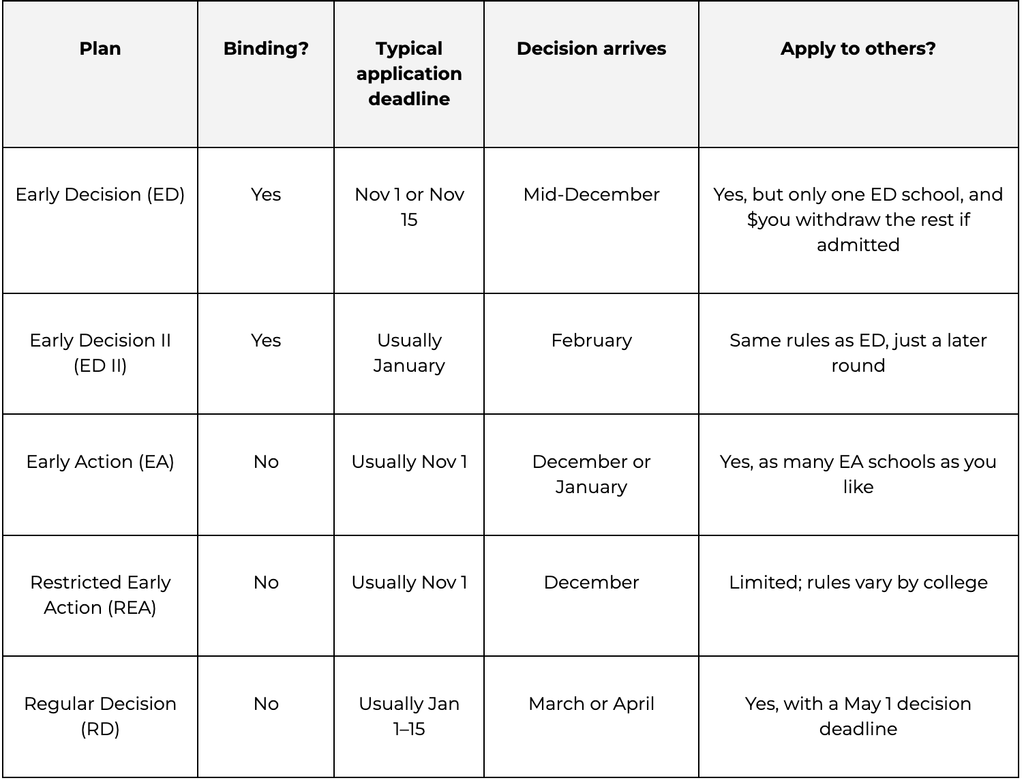
Some colleges, such as Baylor University, now say “Binding Admission” and “Nonbinding Admission” instead of ED and EA. However, the meaning is the same.
ED is more than checking a box on the application. Here is what the commitment looks like, step by step:
Most ED agreements say a student may ask to be released if the financial aid offer does not make attending possible. This is a narrow exit, not a way to shop around. It is about genuine affordability, usually measured against the family’s demonstrated need, and it does not cover “we got a better scholarship somewhere else.”
Each college words this differently, so it’s important to read the specific school’s ED policy before signing.
The pros of Early Decision
The cons of Early Decision
Sit down together with your Class 101 advisor to answer these honestly. If you can say yes to all of them, ED may be a strong choice. If any answer is “not sure,” Early Action or Regular Decision is likely the safer path.
For students
For parents
Early Decision is a strategy, not a default. At Class 101, every student applies Early Action, and most submit the bulk of their applications before EA and ED deadlines, because materials are built steadily throughout high school instead of rushed in the fall of Senior year. That head start is what makes ED a real option rather than a gamble.
Our advisors help families weigh ED against EA and Regular Decision, check the numbers before anyone signs, read each college’s fine print, and build a college list with a solid plan B. If you are wondering whether ED makes sense for your student, schedule a free consultation and let’s talk it through.

October 22, 2026
If we look at the past two decades of technology in education, we see a steep incline in the resources and tools available to students. A mark of success today is being able to take those tools and use them to your advantage while still keeping a sense of creativity and individuality. The use of […]
Read More >
October 2, 2026
Most parents brace themselves for one Senior year of college applications. Class 101 parent, Ashley, had three all under one roof. If the thought of one student navigating essays, deadlines, and decisions feels like a lot, triple it. That’s exactly what Ashley and her triplets, Olivia, Maddie, and Harry, took on this year, with a […]
Read More >
September 18, 2026
For years, students have treated their GPA as the headline number on their college applications. The higher the number, the better their chances, right? Not necessarily. A GPA remains an important part of the admissions process, but it’s not a universal measurement. A 4.0 at one high school may represent something very different than a […]
Read More >