May 20, 2026




By the middle of May, I can usually tell which juniors are going to feel steady heading into the fall and which ones are going to feel like everything showed up at once.
It rarely has anything to do with how strong the student is academically.
It almost always comes back to whether they have started building a real college list.
Most students I meet with in Brookfield, Waukesha, Wauwatosa, and around Milwaukee will tell me they already have a list. When I ask them to walk me through it, what I hear is usually a handful of familiar names.
UW–Madison comes up almost every time. Minnesota is common. Marquette is usually in there. Sometimes a couple of other schools that friends or older siblings have mentioned.
That is not really a list. It is a starting point.
A college list only becomes useful when it reflects some level of thought about where a student is likely to be admitted, what those schools are likely to cost, and how well they actually fit the way that student learns and operates. Without that, students are just collecting options without understanding them.
The timing of this matters more than most families realize.
When the list does not come together until June or July, everything else starts to feel rushed. Students are visiting campuses without a clear sense of what they are trying to evaluate. Testing decisions are made without understanding how a score might change outcomes at specific schools. Essays get started before there is real clarity about where they are applying.
By the time August arrives, there is technically a list in place, but it often feels unsettled. Schools get added or dropped late. Questions about cost start to come up after decisions have already been made about where to apply. Nothing is necessarily wrong, but everything feels a little compressed.
What I like to see by this point in May is something more stable.
A student does not need to have every school finalized, but they should have a clear sense of the range they are working within. They should understand which schools are more likely, which are more competitive, and which ones might depend on how testing plays out. They should have at least a general sense of how those schools might look financially.
Just as important, they should be able to explain why each school is on their list beyond the fact that they have heard of it.
When that level of clarity is in place, everything that follows becomes easier. Visits are more focused. Testing becomes more intentional. Essay writing feels more connected to the schools themselves instead of feeling generic.
This is the point in the year where the gap starts to show.
Some students move into summer with direction. Others feel like they are just getting started at the same time that everything else is picking up.
If you have a current junior in Brookfield, Waukesha, Wauwatosa, or the surrounding Milwaukee suburbs, it is worth asking a simple question right now.
Do we actually have a college list, or do we just have a few names we have been talking about?
If it is the second, that is not a problem. It just means this is the time to sit down and work through it before summer gets away from you.
Because once June hits, everything else starts to layer on pretty quickly.
October 8, 2026
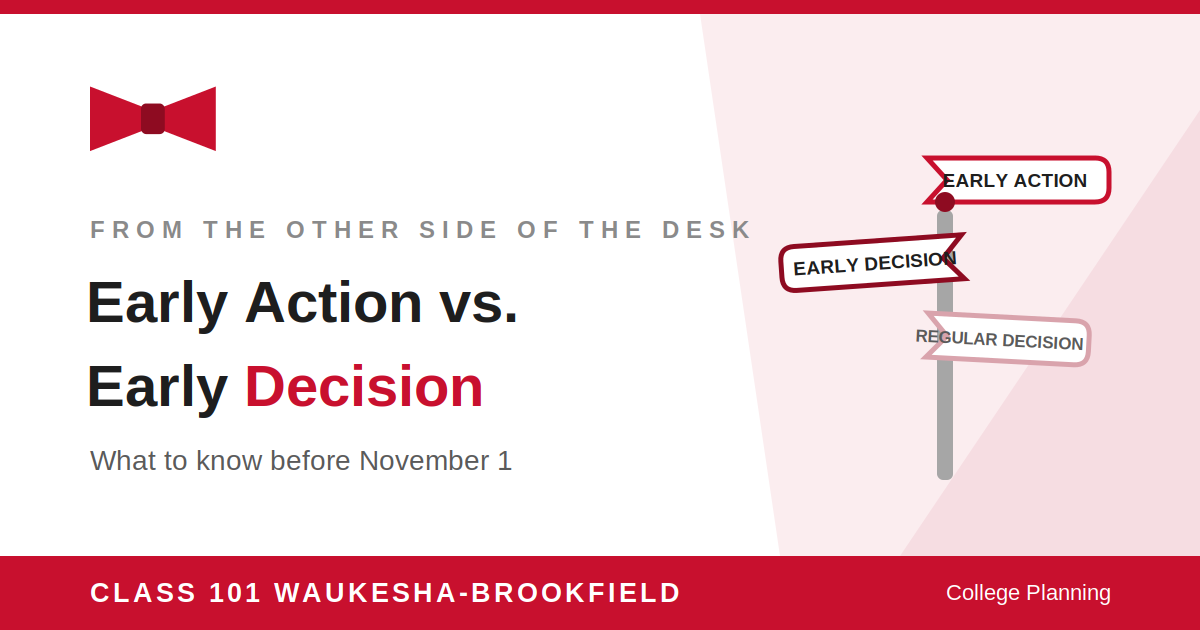
A former admissions VP breaks down Early Action vs. Early Decision, with UW-Madison and Marquette deadlines, for Waukesha and Brookfield families.
Read More >
September 17, 2026
From Class 101 Waukesha-Brookfield, guiding seniors and their parents through application season across Waukesha County and the greater Milwaukee area. If you have a senior in Brookfield, Waukesha, or anywhere in the Milwaukee area right now, your household is probably running on some combination of deadlines, rumors, and whatever the parent group chat decided last […]
Read More >
September 3, 2026
(and Why It Matters for Your Milwaukee-Area Senior) From Class 101 Waukesha-Brookfield, serving families in Brookfield, Waukesha County, and the greater Milwaukee area. Every September, families across southeastern Wisconsin sit down at the kitchen table and ask some version of the same question: what should we be doing right now? It’s a fair question. Here’s […]
Read More >