May 13, 2026




As we get into mid-May, I start to see a shift with families across Brookfield, Waukesha, Wauwatosa, and the greater Milwaukee area.
Spring sports are wrapping up. AP exams are underway or just finishing. Seniors are posting their decisions. And for families with current juniors, there is a growing sense that summer is going to matter.
What often hasn’t happened yet, though, are the conversations that actually make summer productive.
Before school ends, there are three conversations every family should have. They are not complicated, but they do require a level of honesty that most families tend to delay.
This is the conversation that gets pushed the furthest down the road, and it is the one that causes the most stress later.
I regularly work with families from Brookfield and Waukesha who assume they will “figure it out” once financial aid offers come in. The problem is that by the time those offers arrive, the student’s list is already set. The options are already limited.
Every college has a different pricing structure. Merit scholarships vary widely. A student who is a strong candidate at one school may receive a very different offer from another school that looks similar on the surface.
Without an early understanding of what is realistic, students build lists based on interest rather than affordability. That is how you end up in April of senior year trying to reconcile excitement with numbers that do not align.
This conversation does not need to produce a perfect answer. It does need to produce a working range.
This sounds like a simple question, but it is often answered with assumptions.
Families will say they want a “good school,” or they will reference places like UW–Madison, Marquette, or Minnesota because those are the names they hear most often in the Milwaukee area. There is nothing wrong with those schools, but they are not interchangeable, and they are not automatically the right fit for every student.
Fit is not just about rankings or reputation. It is about how a student learns, how they engage, and what environment allows them to succeed.
Does your student thrive in large, fast-moving environments, or do they benefit from more structure and smaller class settings? Are they likely to seek out opportunities, or do they need those opportunities to be more intentionally built into the experience?
These are the kinds of questions that should shape a college list. Without them, students often end up applying to a group of schools that look good on paper but do not align particularly well with how they operate.
This is the conversation that tends to sit just below the surface.
In many families, especially in high-achieving communities like Brookfield and Wauwatosa, there is a natural tendency for parents to take the lead. The stakes feel high, and parents want to make sure nothing is missed.
At the same time, the most successful outcomes usually come when the student has a meaningful level of ownership.
That does not mean the student is left to figure everything out alone. It does mean they are engaged in the decisions, they understand the reasoning behind the list, and they are taking responsibility for the work that follows.
If a student enters summer without that ownership, it often shows up in August when essays have not been started and deadlines begin to feel closer than expected.
Once the school year ends, the structure that has been holding everything together disappears. Schedules change. Travel picks up. Summer jobs begin. Without a plan, it becomes very easy to lose momentum.
Families who have had these conversations in May tend to use June and July differently. Their students approach essay writing with more clarity. Their college visits are more intentional. Their testing plans are already in motion.
Families who delay often find themselves trying to make up ground later.
If you have a current junior in Brookfield, Waukesha, Wauwatosa, or the surrounding Milwaukee suburbs, this is a good moment to step back and ask whether these conversations have happened yet.
They do not need to be perfect. They do need to be started.
Because what happens over the next few months will shape how senior year feels.
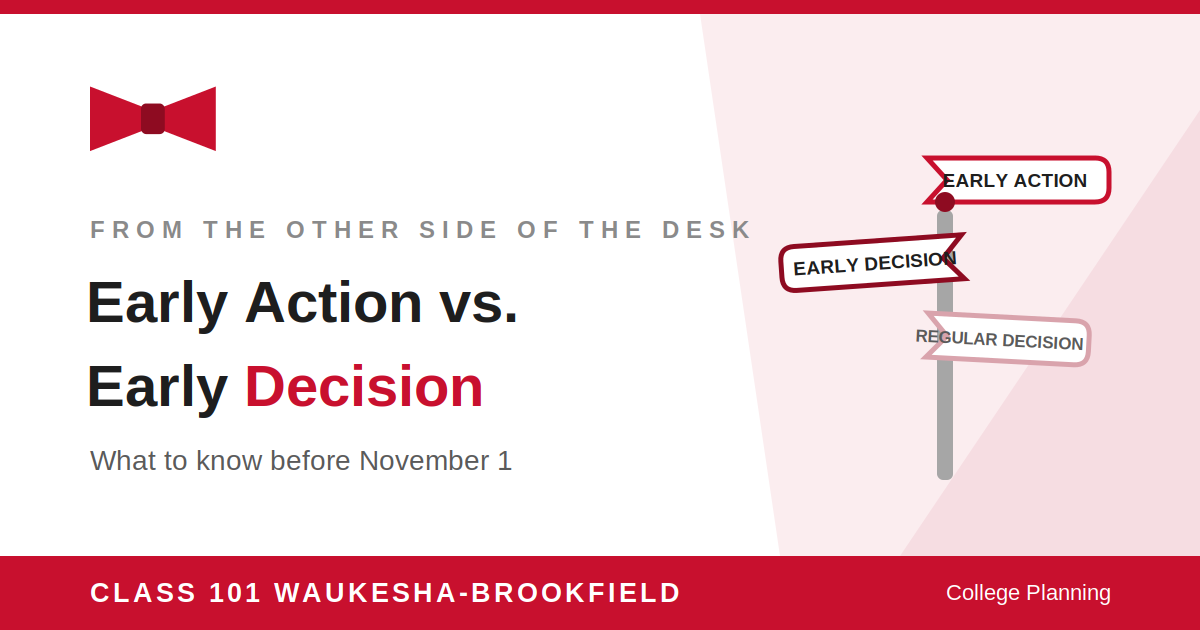
October 8, 2026
A former admissions VP breaks down Early Action vs. Early Decision, with UW-Madison and Marquette deadlines, for Waukesha and Brookfield families.
Read More >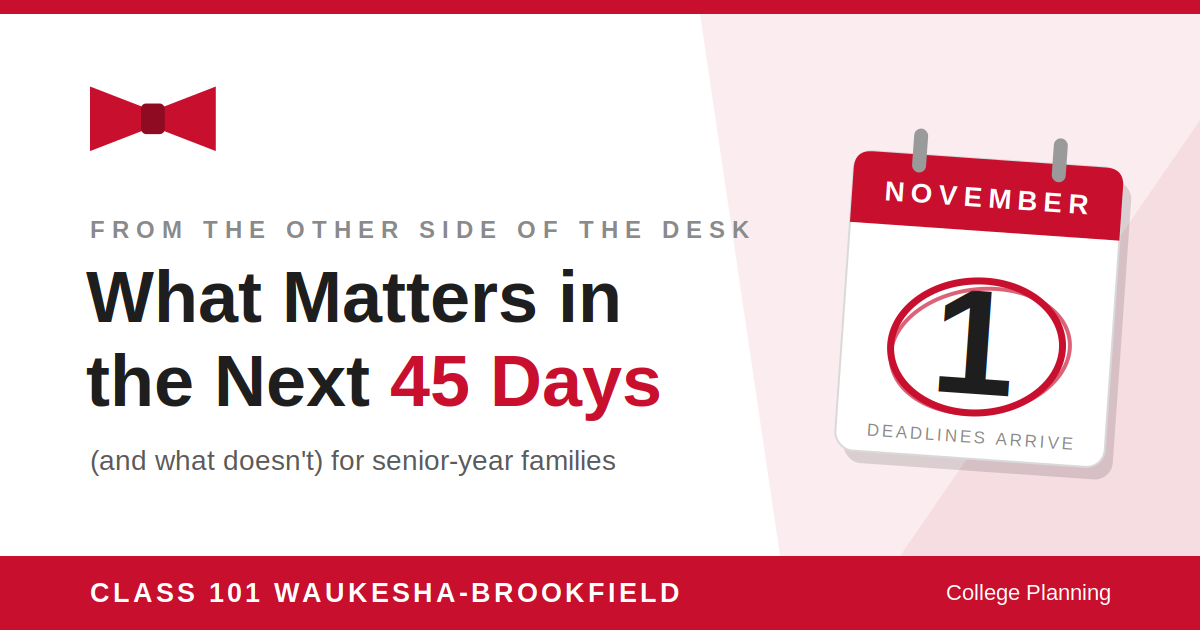
September 17, 2026
From Class 101 Waukesha-Brookfield, guiding seniors and their parents through application season across Waukesha County and the greater Milwaukee area. If you have a senior in Brookfield, Waukesha, or anywhere in the Milwaukee area right now, your household is probably running on some combination of deadlines, rumors, and whatever the parent group chat decided last […]
Read More >
September 3, 2026
(and Why It Matters for Your Milwaukee-Area Senior) From Class 101 Waukesha-Brookfield, serving families in Brookfield, Waukesha County, and the greater Milwaukee area. Every September, families across southeastern Wisconsin sit down at the kitchen table and ask some version of the same question: what should we be doing right now? It’s a fair question. Here’s […]
Read More >